Prologue to the Fascinating Story of the Encounter of a Visionary and a Historian
The relationship between architect Tadao Yoshijima and historian Teiji Ito reveals how an overlooked house in Takayama became the unlikely center of a wider rediscovery of Japan’s minka tradition and postwar architectural thought. This prologue traces the improbable beginnings of that encounter.
Hajime Yatsuka
Beneath the impressive play of three-dimensional wooden frameworks of the old house (minka)—which recalls Arata Isozaki’s City in the Air, emerging from Kenzo Tange’s Tokyo Bay Plan (1960)—quietly sits the house’s owner, Tadao Yoshijima, now in his eighties. The faint smile on his face reveals nothing of the harsh dramas of his long and often disappointing life. I speak not only of his life as the owner of this legendary minka, but also as a visionary architect, who was never fairly recognized as he deserved to be. Both roles might have faded from public memory. Yet, there was a saving grace. His “savior” was Teiji Ito, a prominent historian of Japanese architecture. For just as Yoshijima was more than a homeowner but also a visionary, Ito was more than an authoritative scholar of minka, but also a sharp critic of contemporary architecture. From this house, and through the historian’s intervention, emerged a complex web of architectural thought and theory, whose scale and range extended far beyond what one might associate with such a serene house and reserved owner. The forming of this web was rather miraculous. From this spatial-temporal knot, one can trace a fascinating field of Japanese avant-garde architectural culture, rich in implication and insight. To decode this field requires none other than imagination and sympathy. This brief prologue is an attempt to record that story of discovery and salvation—the story of the discovered and its discoverer.
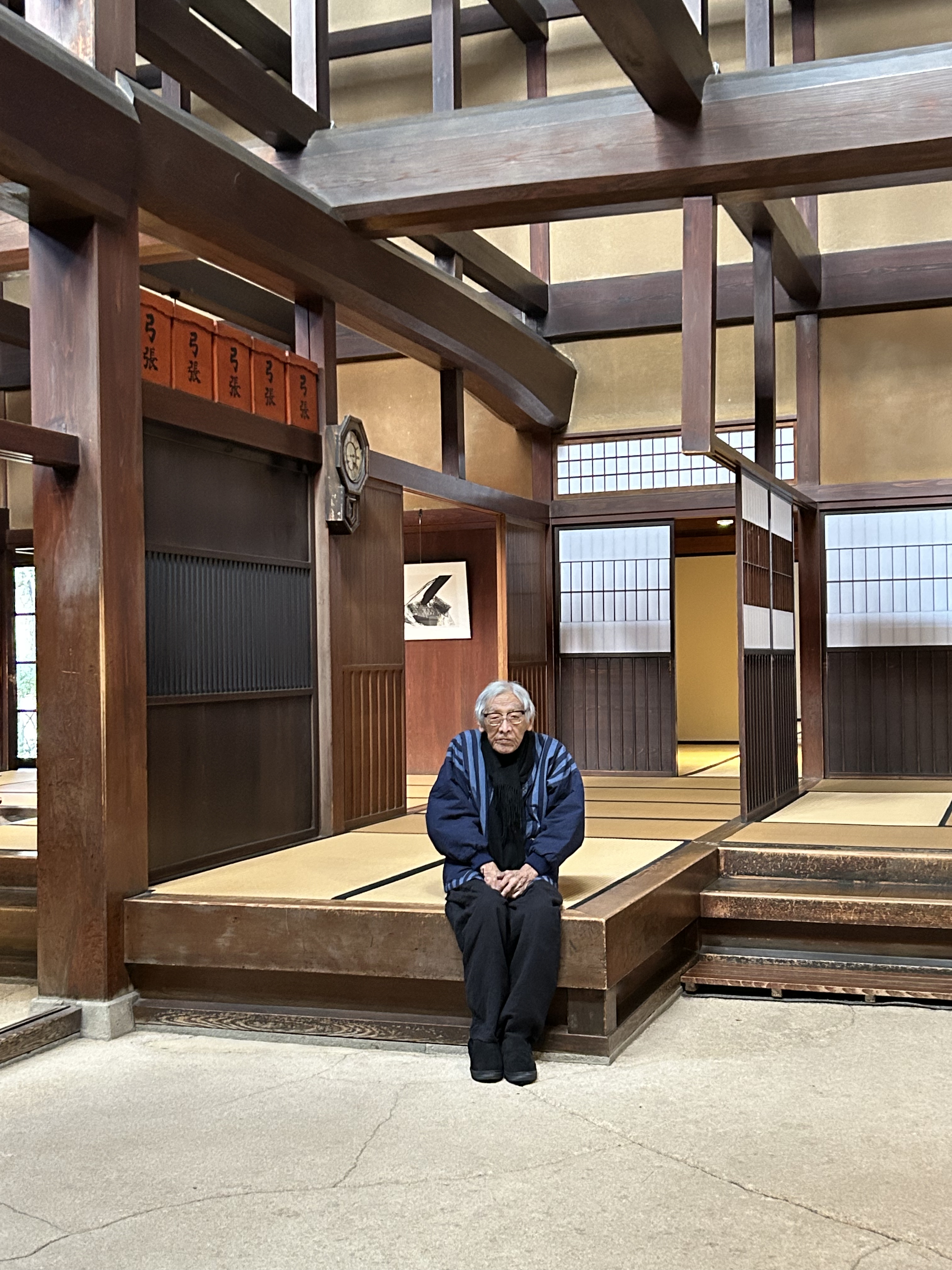
Architect Tadao Yoshijima seated in his minka, the Yoshijima House.
Today, the Yoshijima family residence is also relatively well-known abroad. Charles Moore once remarked that it was worth traveling from the other hemisphere of the planet to see it. Yukio Futagawa, later the president of Global Architecture Japan and the first to photograph and publish the Yoshijima House, compared it to the Parthenon in Athens. Readers of this text may have encountered images of the house in Western publications. Yet, it is little known that the house was never regarded as an important legacy in the history of Japanese domestic architecture before 1950.
In the mid-1950s, Futagawa, then an amateur photographer in his twenties, began documenting minkas throughout Japan. It should be noted that the architectural academy had scarcely recorded the minka’s locations and specifications. Yasushi Tanabe, a professor at Waseda University and the first historian to write a book on Japanese domestic architecture, suggested that Futagawa visit Takayama to see the Kusakabe House, another monumental minka adjacent to the Yoshijima House. Deeply impressed by the beauty of the old house (though his reaction to the Yoshijima House remains unknown, as the house may have been in a deteriorated state), Futagawa decided to embark on a wider survey, strongly supported by the president of the publication company, Bijutsu Shuppan-sha, who eventually proposed the publication of the canonical ten-volume Nihon no Minka (Japanese Minkas).
Futagawa needed a scholar to write the accompanying text for the series. He asked his friend from Kenzo Tange’s laboratory at the University of Tokyo, Arata Isozaki, to recommend a possible collaborator. Isozaki suggested Teiji Ito, nearly ten years their senior, but still in his early thirties. Ito had been an ally of the younger Isozaki after recovering from a long illness. When Ito learned of Isozaki, then an ambitious architecture student engaged in leftist political activism in the provincial villages around Mt. Fuji, he advised Isozaki that it was not the right place for his talents. This advice led Isozaki back to Tange’s studio in Tokyo. If not for this small episode, the careers of these two prominent figures, the historian and the architect, might have taken very different paths. Isozaki owed much to his elder friend.
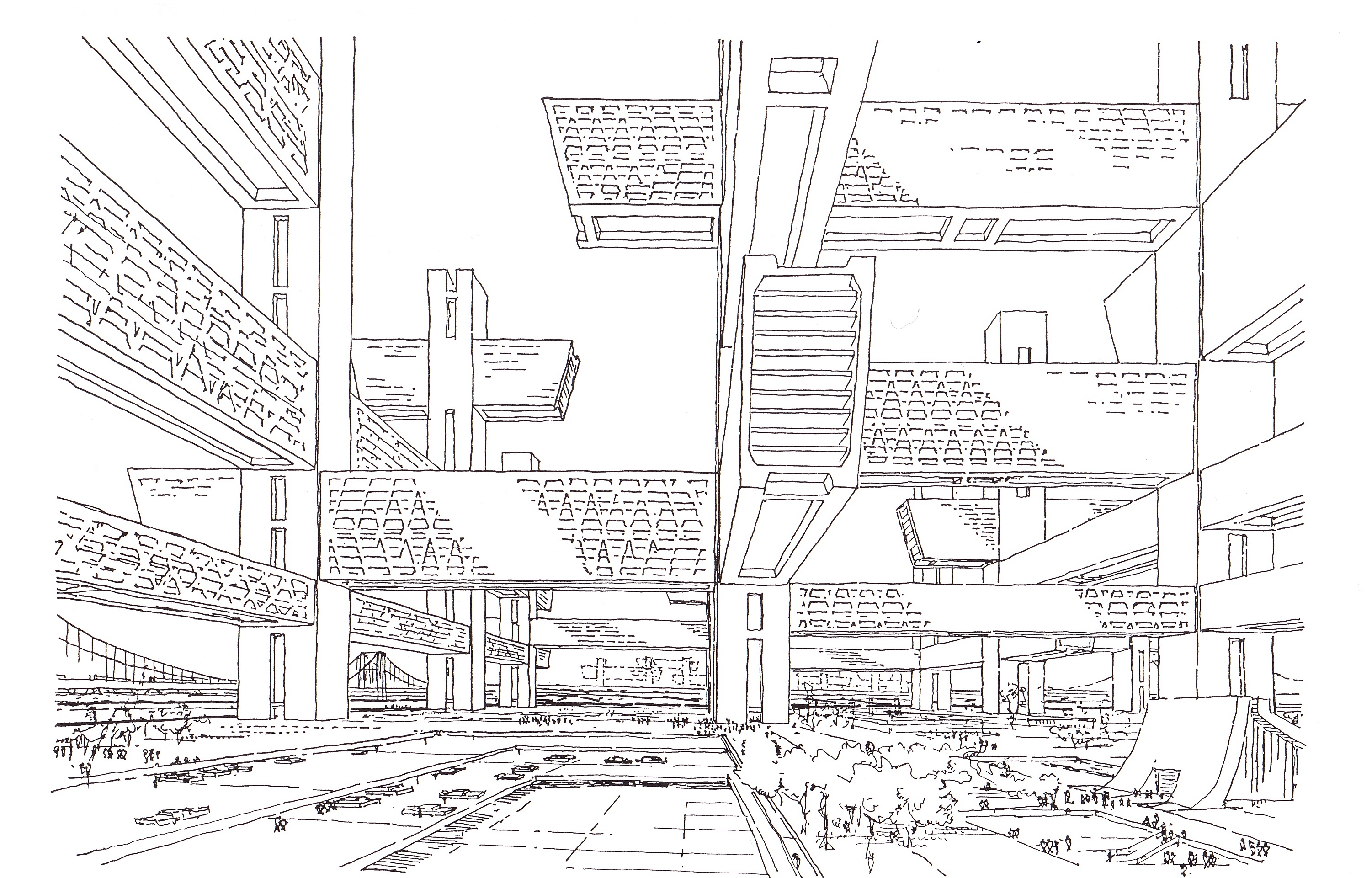
Kenzo Tange's A Plan for Tokyo sketch.
Reflecting on the state of old Japanese minkas in a 2004 interview about the legendary collective survey Japanese Urban Space (Nihon no Toshi-Kukan), Isozaki noted that structures like the Kusakabe House in Takayama, Gifu, and the townscape of Imai-chō, Nara, were discovered in the 1950s. Though they are now recognized and registered as cultural heritage, they were scarcely known to the public at the time. Isozaki himself was not directly involved with those discoveries, but he was very close to the discoverers: both he and Ito led the Japanese Urban Space project. In the series of essays that will follow this short prologue, I will examine more closely the relationship between the historian-critic and the architect. Japanese Urban Space may be seen as a twin of Ito and Futagawa’s discovery of the Yoshijima House. But for now, let us focus on the house itself.
At first, Ito only discovered the house. After Nihon no Minka was awarded the prestigious Mainichi Publishing Culture Award in 1959, the Kusakabe and Yoshijima houses gained sudden and dramatic prominence among the Japanese public. This recognition was the outcome of Ito’s discovery. Initially, Ito had difficulty acquiring permission to photograph the house from its owner, the sixth Kyūbei Yoshijima. For the old man, who had lived his entire life outside the conventions of modern society, the photographing and publishing of his own home was incomprehensible—he was at a loss for how to react. Ito also encountered the high school boy, Tadao, who was to inherit the master of the family’s name and become the seventh Kyūbei. Of course, Ito had no idea that he would one day write a book about this boy, almost half a century later. In Kenchiku-ka Kyūbei (Kyūbei the Architect, 2001), Ito recalled seeing the boy at his back, but without exchanging any words. Ito was simply overwhelmed by the beauty of the house, while Futagawa had already begun photographing it without the father’s consent. Another discovery—one that would continue until Ito’s death in 2010—was yet to come.
(to be continued)
- Hajime Yatsuka is an architect and emeritus professor at Shibaura Institute of Technology in Tokyo. His publications include Le Corbusier: Urbanism as Biopolitics (2013), Metabolism Nexus (2011), Shiso toshite no Nihon kindai kenchiku (2005).